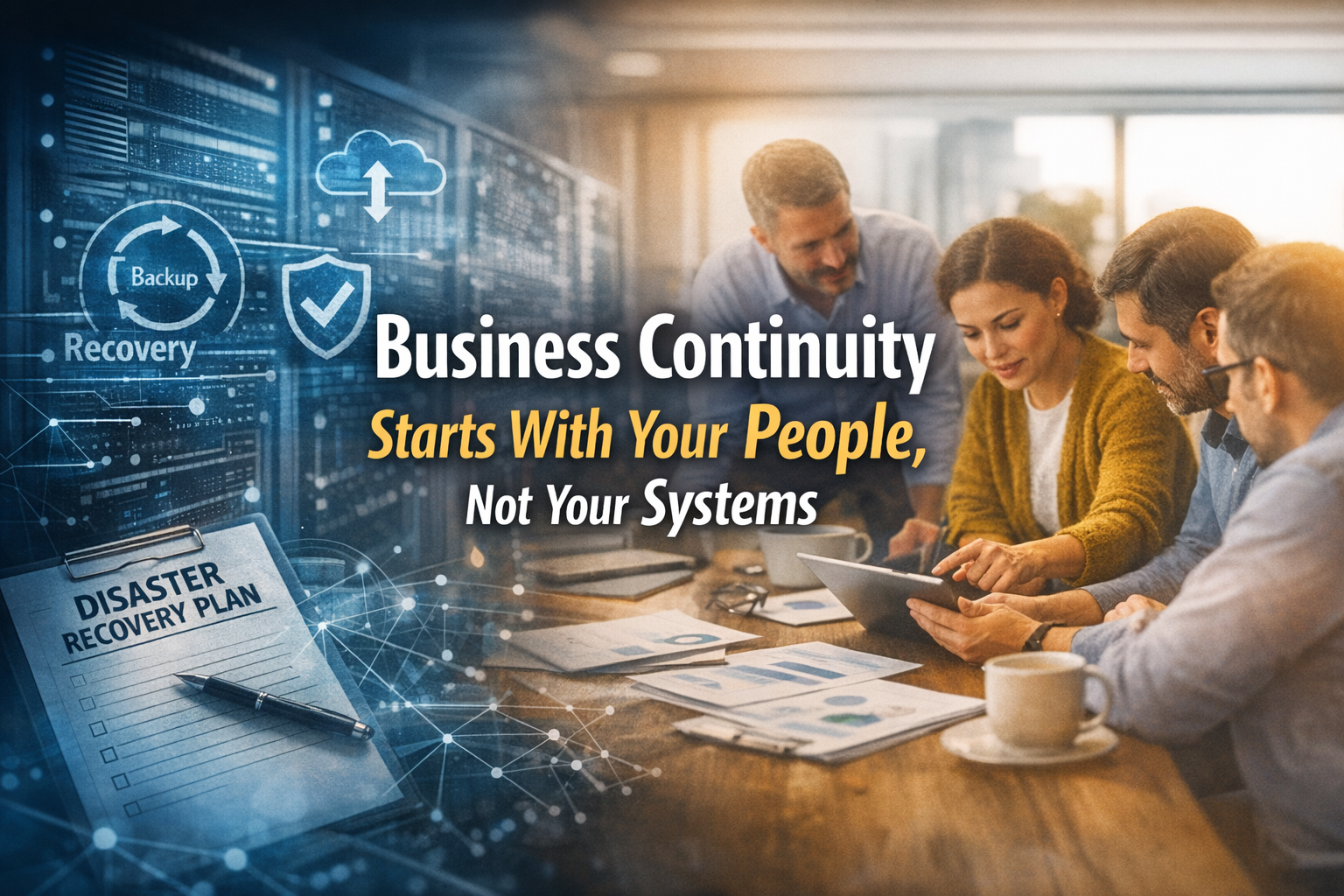
When most leaders think about business continuity, their minds jump straight to systems:
- Backups
- Servers
- Security tools
- Disaster recovery plans
- Cloud failover
Those things matter — a lot.
But they’re not where continuity truly begins.
But they’re not where continuity truly begins.
Because when something critical happens, the first thing that determines whether your business stays operational isn’t a piece of technology.
It’s your people.
1. Technology Can Recover Data — People Recover the Business
You can restore a server.
You can fail over to the cloud.
You can spin up remote access within minutes.
You can fail over to the cloud.
You can spin up remote access within minutes.
But none of that matters if:
- Your team doesn’t know what to do
- Roles aren’t clearly assigned
- No one communicates
- Decisions stall because no one feels responsible
Technology gets you operational.
People get you moving.
People get you moving.
Continuity takeaway:
Your systems may come back online quickly — but your business won’t if your team isn’t trained, aligned, and prepared.
2. The Biggest Vulnerability in Most Organizations Isn’t Technical — It’s Human
When real-world disruptions hit —
power outages, cyberattacks, network failures, a key employee suddenly unavailable —
the bottlenecks rarely show up in the technology itself.
power outages, cyberattacks, network failures, a key employee suddenly unavailable —
the bottlenecks rarely show up in the technology itself.
They show up in:
- Confusion over who’s in charge
- Employees waiting for instructions
- Staff who don’t know processes outside their routine
- A single person holding critical knowledge
- No clear communication channel for emergencies
Most continuity failures aren’t caused by system downtime.
They’re caused by people not being ready for system downtime.
3. People Make Decisions Faster Than Any Disaster Recovery Plan
In a crisis, minutes matter.
When roles aren’t defined, teams default to waiting.
When responsibilities are unclear, tasks stall.
When communication channels aren’t established, misinformation spreads.
When responsibilities are unclear, tasks stall.
When communication channels aren’t established, misinformation spreads.
A well-prepared team:
- Knows who leads each part of the response
- Knows where to go for information
- Knows the first 3 steps to take
- Doesn’t panic when routine breaks
- Doesn’t lose time arguing about ownership
A disaster recovery document exists on paper.
A business continuity culture exists in muscle memory.
A business continuity culture exists in muscle memory.
4. Business Continuity Is a Leadership Function — Not an IT Function
Here’s the mistake many organizations make:
They treat continuity as an “IT thing.”
It’s not.
IT is part of continuity.
But the responsibility spans:
But the responsibility spans:
- Leadership
- Operations
- Finance
- HR
- Communications
- Every department affected by downtime
The strongest organizations build continuity into how they operate — not just how they back up files.
Continuity takeaway:
Technology supports continuity.
People deliver it.
People deliver it.
5. The Human Side of Continuity: What Strong Organizations Do Differently
The most resilient companies share the same human-focused habits:
📌 They document processes in plain language
Not just technical steps — actual business workflows.
📌 They train their teams regularly
Not once, but as an ongoing rhythm.
📌 They define roles clearly before a crisis happens
Everyone knows who leads what.
📌 They remove single points of failure
No one person can “hold all the keys.”
📌 They communicate openly and early
Silence is never the default during disruption.
📌 They practice—not just plan
Tabletop exercises. Scenario walkthroughs. Skills repetition.
These are human behaviours, not software features.
6. Systems Can Fail Gracefully — but Teams Need to Be Able to Move Gracefully
A system failover takes seconds.
A team failover takes preparation.
If your continuity planning is built around technology alone, you’ve covered the mechanics — but not the organization.
Because business continuity isn’t defined by:
- How fast a virtual machine restarts
- How quickly your backup restores
- How redundant your infrastructure is
It’s defined by how your people respond, communicate, and coordinate while that happens.
The Real Question to Ask Yourself
If something unexpected happens at 8:15 AM — a cyber incident, a massive outage, a key leader unavailable — what happens next?
Not from a systems perspective.
From a people perspective.
Do they:
- Know what to do?
- Know who to call?
- Know their role?
- Stay calm and execute?
- Keep the business moving?
Or does everything stall until someone “figures it out”?
Because that is the true test of continuity — the human test.
Final Thought
You can have the best tools, the best backups, and the best recovery platforms.
But continuity isn’t built on systems alone.
It’s built on people who know exactly how to respond when the systems fail.
If you want a resilient organization, your technology needs a plan —
but your people need one even more.
but your people need one even more.