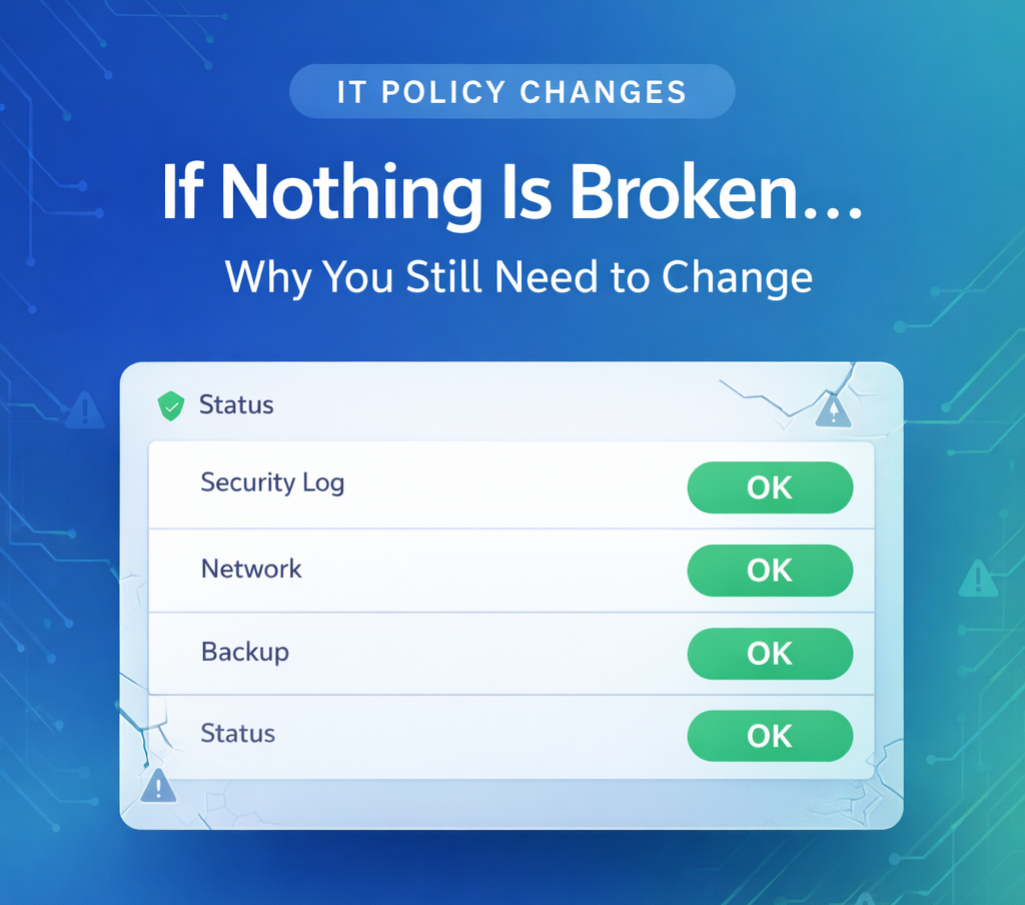
It’s one of the most common questions in IT:
“Why are we changing this? Everything is working fine.”
It’s a fair question.
But in cybersecurity, “working fine” doesn’t always mean “secure.”
Technology Changes Faster Than Risk Awareness
Cyber threats evolve daily.
What was considered secure three years ago may now be considered high risk.
What was considered secure three years ago may now be considered high risk.
Examples:
- Password‑only logins
- Open admin access on workstations
- Unrestricted USB usage
- No conditional access policies for remote work
Policies must evolve because threats evolve.
Standing still in cybersecurity is the same as falling behind.
Convenience vs. Protection
Many outdated practices exist because they’re convenient:
- Local admin access makes installs easier
- Shared credentials reduce friction
- Skipping MFA saves a few seconds
- No restrictions feels “simpler”
But convenience and security often pull in opposite directions.
A good IT partner minimizes disruption while strengthening protection.
Small Gaps Lead to Large Incidents
Most cyber incidents don’t start with sophisticated hacking.
They start with:
- A phishing email
- A compromised password
- An outdated device
- Excessive user permissions
Without clear policies in place, one small vulnerability can spread quickly across an organization.
Policies act as containment barriers.
Security Is a Leadership Decision
Strong IT policies reflect leadership maturity.
They signal:
- We protect client data.
- We take risk seriously.
- We operate professionally.
- We plan ahead.
Even if staff never see the behind‑the‑scenes protections, leadership should.
The Cost of Waiting
When organizations delay policy improvements, they’re often making a silent decision:
“We’ll deal with it after something happens.”
But “after” means:
- Downtime
- Reputation damage
- Emergency remediation costs
- Potential legal exposure
Preventative security is predictable and budgeted.
Reactive security is chaotic and expensive.
Reactive security is chaotic and expensive.
Final Thought
The goal of IT & security policies isn’t to fix what’s broken.
It’s to protect what’s working.
And when everything seems “fine,” that’s actually the best time to strengthen your foundation.
Because security isn’t about responding to yesterday’s incident — it’s about preventing tomorrow’s.